Pages

Saturday, 18 February 2017

Top Tips for New Teachers

Top Tips for New Teachers

1. Be Consistent
Establish your classroom management system and be consistent when implementing it. Giving students a secure, stable environment where they know where they stand and what to expect will save you and your students a lot of frustration in the long term. Children learn best when they feel safe and secure and having a consistent classroom management system is key.  So establish it, implement it and make sure you follow through with it!

2. Just say no
Do not feel guilty about saying no to extra responsibilities. As a new teacher (and an experienced one!) there are so many things to learn in terms of managing your class, planning lesson, assessments, parent communication and so on and  these can often seem daunting  on their own, never mind taking on extra roles. Do not be afraid to say no to running that after school club or organising that science week. If you feel ready to take it on, then go ahead, but do not feel pressurised into going above and beyond. You are a new teacher and learning how to manage your class is your number one responsibility.

3. Use your planning time effectively
Try to get as much of your work done in school as you can. Before your planning time starts know what it is that you want to achieve.  This could be getting next week’s planning done, making copies, marking a set of books etc. Try not to get distracted and stay focused on your task. Try to find a quiet place to work (not always easy in a school, I know!). Try to have all your resources ready, i.e. planning templates, worksheets to print out on a storage device etc. so you are ready to go. This time is yours, so make the most of it!

4. Don’t struggle alone
Find a trusted mentor and ask them for advice if you need to. If you are struggling with a particular child or you are looking for ideas about how to teach a particular tricky concept, don’t be afraid to ask for help. While googling is great for this too, it doesn’t beat talking through ideas face to face. Find someone you trust and don’t be afraid to ask. In the UK you should have an assigned mentor during your first year and this is what they are for!

5. Learn to draw a line under your work
It took me a few years to accept that there will always be something else to do when it comes to teaching, but it’s fine if I don’t manage to do it all! Teaching is a practice where there are many ways of doing things and there is always something else you can do to improve, but the quicker you learn to accept this and be ok with it, the better. Your students would much rather have a refreshed teacher who is well rested than a tired, frazzled teacher who has been up all night planning and replanning a lesson because there was ‘something else that could be done’. Learn to draw cut off points and stick to them.

6. Go to staffroom at lunch
You need a break away from the classroom during the school day. Make sure you make time during lunch to spend in the staffroom. Get to know your colleagues and spend time with them. You will feel ready for the afternoon session after a decent lunch break!

7. Go with the flow
I used to get frustrated when that lesson I’d carefully planned was interrupted by a surprise visitor or an extra singing practice for the school concert. Learn to accept that this is school and things often don’t run as expected. So don’t worry and just pick up where you left off tomorrow. At least all your prep will be done!

8. Make time for yourself
As much as you can, try to leave school work at school – where it belongs! You need to make time for yourself and be able to relax and spend time with your friends and family. This can be harder than it sounds (see point 5), but it is important to step away from work and make time for yourself so you are refreshed when you step back into the classroom. Make sure that you make time for your own hobbies and interests away from school.

10 Classroom Procedures that Will Save Your Sanity

10 Classroom Procedures that Will Save Your Sanity
The difference between a good procedure and a bad procedure is the difference between “everything is running fairly smoothly” and “this is driving me nuts. I’m gonna’ pull my hair out.”
Sometimes it’s easy to think of a procedure, and other times, a question will have us stumped for years.
Take pencils for example.
They’re these little lead things, y’know. They shouldn’t cause so much trouble.
But I’ve spent years trying to figure out how to keep my kids supplied with pencils. There just seemed to literally be no simple solution.
Until I finally heard an idea this summer that just might work! (more on that in a sec….)
10 classroom procedures that will save your sanity
So with school starting soon and procedures on everyone’s mind, I thought I’d share a few procedures that have worked well for me – and a couple awesome ideas I’ve run across since I’ve stepped out of the classroom (like that pencil thing….)

10 Classroom Procedures that Will Make Things Run More Smoothly

  • Tell kids they can’t use the restroom. Okay, I know that sounds crazy, but hear me out. When kids ask to use the restroom during instructional time, my typical answer is, “no not right now.” Sometimes I follow this by telling them a time they can go, telling them I’ll let them leave class a minute early, or telling them I’ll write them a pass to have a couple extra minutes to go between classes, but the gist of the answer is “not right now.” The thing about saying no right away is that if the student really has to go, they’ll ask again (more urgently) in a few minutes. At which point you go ahead and say yes.  
      
  • Use short phrases like “prepare for a quiz” that stand for a combined set of directions. I teach my students that when I say “Prepare for a quiz” they are to clear their desk of everything except a pencil and a clean sheet of paper to use as a cover sheet. They are also to have a pen handy to grade. At first this takes a lot of instruction, but later in the year all I have to say is “prepare for a quiz,” and the rest happens (somewhat) automatically.  
      
  • Use call-and-response sayings to get your class’s attention. Basically you teach your students to respond when you call out something. So, for example, you say “All set?” and your students respond with “You bet!” This is infinitely better than just asking your students to be quiet because when they respond “You bet!” they actively stop what they are doing & refocus on you. I wish so much I had known about these when I was teaching – it would’ve prevented so much frustration! (, or for more info check out Whole Brain Teaching.)  
      
  • Teach your students to use question marks when grading in class. When your students are grading work in class, don’t take grading questions. You just don’t have time for a million versions of “is it okay if Jerry didn’t capitalize the first letter?” Instead, teach your students to put a question mark by any question they’re not sure is correct. Then look at the question marks when you record the grades.  
      
  • Go over tests at the end of the class period. If you try to go over a test at the start of class, you’ll never know how long you’ll spend on it or how many arguments you’ll get about why such-and-such answer really should be fine. Instead, if you want to spend 10 minutes going over a test, stop class 10 minutes early to go over it. That way, you are pretty much guaranteed to only spend 10 minutes, and if anyone has serious questions they can stay after class to ask them. 
      
  • Have students pass their papers backwards or sideways. This may not seem like a big deal, but if you have your students pass their papers forward, they can’t see them coming. So Brandon has to poke Celeste 5 times with the stack of papers or ends up banging her over the head. Instead, have your students pass their papers over and/or backwards so they can see them coming their way. Oh, and if you train the last student who ends up with the papers to paperclip them and put them in a designated spot, that’s one less thing for you to worry about.  
      
  • Have designated in bins. Simple enough, but so many teachers don’t do this. Have a spot for that last student to put the stack of papers. And for students to turn in late work or work from when they were absent.  
      
  • Have students pass back papers for you. Now I’m not talking about tests or anything confidential, but if your classroom’s anything like mine, there are plenty of papers that need to be passed back that students can definitely help with. I create an “out” bin for each of my classes. Then I have one student per class (they normally take a turn for a month or two) who is trained to grab whatever’s in the out bin and pass them out at the start of class.  
      
  • Have an absent secretary. Designate a student to write down what you do in class each day and what the homework is. Keep this list in a special folder so that absent students (or their parents) can easily find what they missed when they return. Here’s an example of the form I used
      
  • Purchase & give out golf pencils. Okay, so I just heard about this idea this summer in our Create Your Dream Classroom summer book club, but it sure sounds like it’s worth a try. You know that impossible pencil situation? Buy a couple boxes of golf pencils (like these) and hand them out when your students don’t have a pencil. They are so many (& they’re cheap enough) that it doesn’t matter whether or not you get them back. And since students don’t like that they’re so small and have no erasers, they’re more motivated to bring their own. Sounds ingenious to me (insert evil laugh). ðŸ™‚

EEC

Image result for EEC established

Member countries of EEC

Members

The six states that founded the EEC and the other two Communities were known as the "inner six" (the "outer seven" were those countries who formed the European Free Trade Association). The six were France, West Germany, Italy and the three Benelux countries: Belgium, the Netherlands and Luxembourg. The first enlargement was in 1973, with the accession of Denmark, Ireland and the United Kingdom. Greece, Spain and Portugal joined in the 1980s. The former East Germany became part of the EEC upon German reunification in 1990. Following the creation of the EU in 1993, it has enlarged to include an additional sixteen countries by 2013.
  Founding members of EEC
  Later members of EEC
FlagStateAccessionLanguage(s)CurrencyPopulation
(1990)[17]
Belgium25 March 1957DutchFrench and GermanBelgian franc[18]10,016,000
France25 March 1957FrenchFrench franc56,718,000
West Germany/Germany[note 1]25 March 1957GermanGerman mark63,254,000[19]
Italy25 March 1957ItalianItalian lira56,762,700
Luxembourg25 March 1957French, German and LuxembourgishLuxembourgish franc[18]384,400
Netherlands25 March 1957DutchDutch guilder14,892,300
Denmark1 January 1973DanishDanish krone5,146,500
Ireland1 January 1973Irish and EnglishIrish pound3,521,000
United Kingdom[20]1 January 1973EnglishPound sterling57,681,000
Greece1 January 1981GreekGreek drachma10,120,000
Portugal1 January 1986PortuguesePortuguese escudo9,862,500
Spain1 January 1986Spanish[note 2]Spanish peseta38,993,800
Member states are represented in some form in each institution. The Council is also composed of one national minister who represents their national government. Each state also has a right to one European Commissioner each, although in the European Commission they are not supposed to represent their national interest but that of the Community. Prior to 2004, the larger members (France, Germany, Italy and the United Kingdom) have had two Commissioners. In the European Parliament, members are allocated a set number seats related to their population, however these (since 1979) have been directly elected and they sit according to political allegiance, not national origin. Most other institutions, including the European Court of Justice, have some form of national division of its members.

Bill of Rights

Bill of Rights

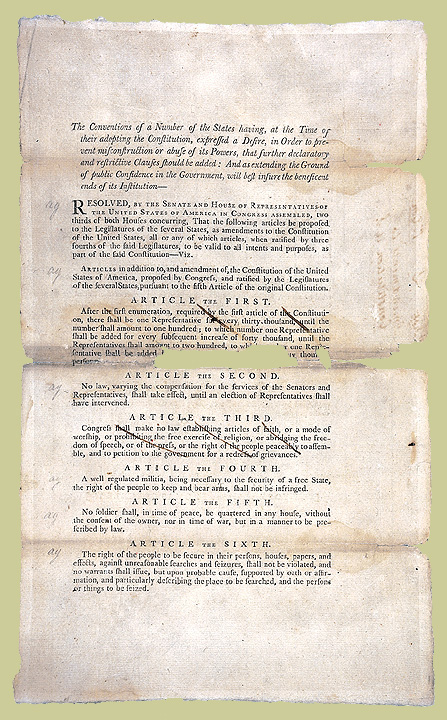
The Bill of Rights

The Bill Of Rights
The Bill of Rights are the first 10 amendments of the Constitution of the United States. They were adopted all at the same time. They were added to the Constitution before the states would approve the Constitution. Since that time, other amendments have been added, but these were the first 10.
1st: Prohibits the making of any law respecting an establishment of religion, impeding the free exercise of religion, abridging the freedom of speech, infringing on the freedom of the press, interfering with the right to peacefully assemble or prohibiting the petitioning for a governmental redress of grievances
2nd: Protects the right to keep and bear arms
3rd: Places restrictions on the quartering of soldiers in private homes without the owner's consent, prohibiting it during peacetime.
4th: Prohibits unreasonable searches and seizures and sets out requirements for search warrants based on probable cause as determined by a neutral judge or magistrate.
5th: Sets out rules for indictment by grand jury and eminent domain, protects the right to due process, and prohibits self-incrimination and double jeoparty
6th: Protects the right to a fair and speedy public trial by jury, including the rights to be notified of the accusations, to confront the accuser, to obtain witnesses, and to retain counsel
7th: Provides for the right to trial by jury in certain civil cases, according to common law
8th: Prohibits excessive fines and excessive bail, as well as cruel and unusual punishment
9th: Protects rights not enumerated in the Constitution.
10th: Reinforces the principle of federalism by stating the federal government possesses only those powers delegated to it by the states or the people through the Constitution.

Said is Dead

alternative the said anchor chart from last year: